
The AI Stat That Should Be Changing How You Make Content (And Probably Isn't)
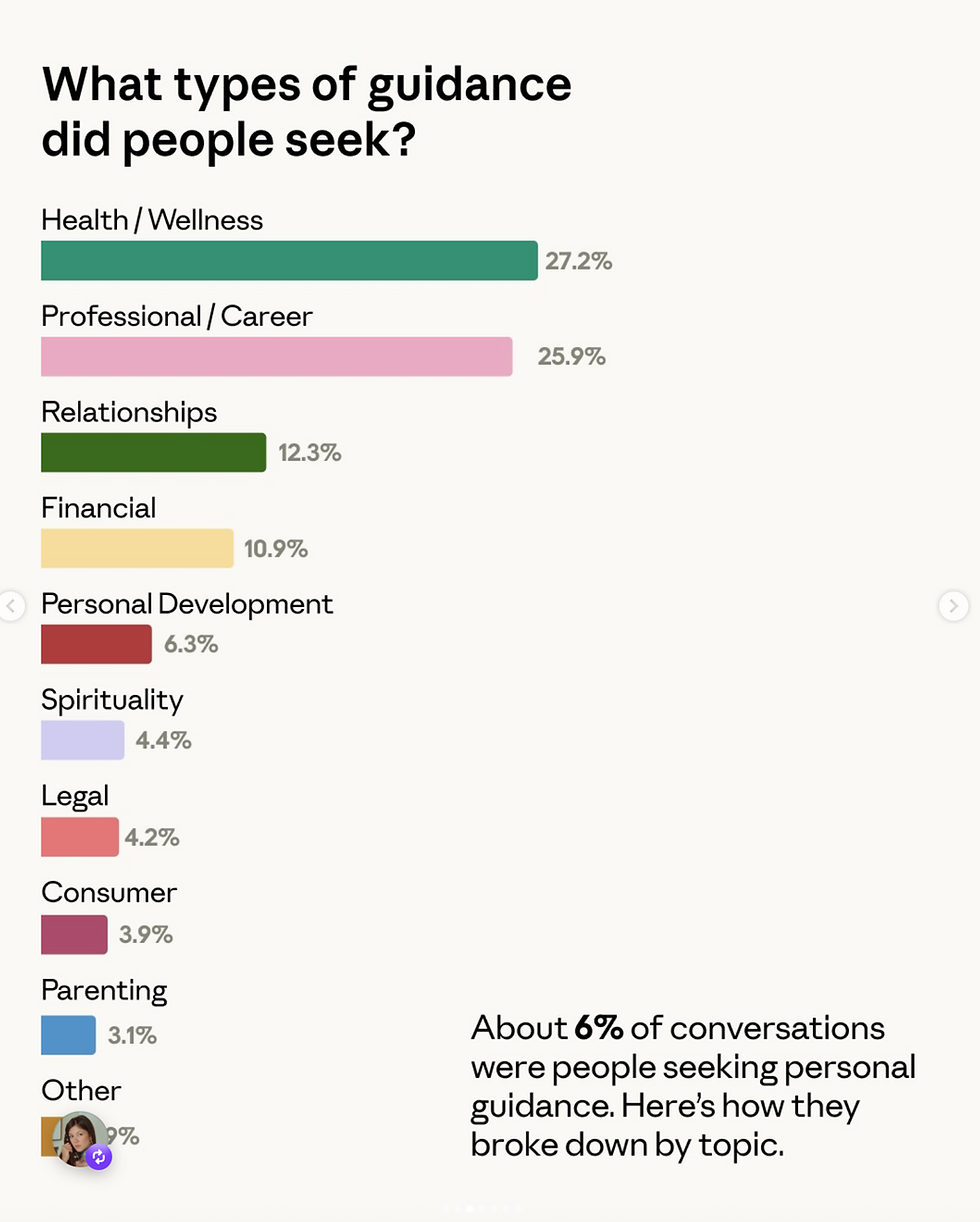
Anthropic published a piece a few weeks ago about how people are actually using Claude for personal guidance. Six percent of all conversations were people asking for help on something in their life. And of that six percent, the largest single category was health and wellness.
Which, to anyone who's ever sat across from a patient, is not exactly breaking news.
Out of every kind of life problem a person could bring to an AI, finance, career, relationships, parenting, the one they're most often asking about is their body. Their symptoms. Their sleep. Their hormones. The weird thing that started happening in week three of their last cycle. We've been watching this exact behaviour happen in the intake form for years. The Anthropic data just gave it a number.
It's not a tech story. It's a diagnostic.
What "Everyone" Is Saying About AI in Healthcare
The standard practitioner response to AI right now falls into one of two camps.
Camp one is panic. AI is going to replace us, patients are going to stop booking, the model knows more than I do, the writing is on the wall.
Camp two is dismissal. AI hallucinates, it gives bad medical advice, real patients still want a real human, this won't change anything.
Both miss what the data is actually saying.
The patients aren't choosing AI over you. They're choosing AI because you weren't there when they needed you. It was 11pm. Their symptom flared. The next available appointment was three weeks out. The intake form was a wall. The cost felt prohibitive. Or, just as often, they didn't even know which kind of practitioner to book in the first place.
So they typed it into a chat window. And the chat window listened.
The Reframe Practitioners Aren't Making
Here's what the Anthropic data is really telling us. People are starving for health guidance. They are so starved for it that they will turn to a model with no training, no clinical context, and no relationship before they will go without.
That is the gap. And the gap is not information. The gap is access, presence, and judgement.
Information is the thing AI just commoditized. Anything a patient could once only get from sitting in your chair, lab interpretation, supplement education, simple symptom frameworks, condition explainers.... AI delivers in fifteen seconds. Faster than you can. At 11pm. Without making them feel stupid for asking.
If your offer is information, AI is now your competitor. And it's a better one on most days, on most metrics, for most patients.
But information was never your real product. It just felt like it because that's what you were paid for in the old model. The 60-minute new patient appointment was sold as access to your knowledge. The thing that actually changed the patient's life was something else entirely. It was you. The synthesis. The way you held seven moving pieces in your head at once and told her which one to pull on first.
That's the work AI structurally cannot replicate. And it's the work most practitioners are still not putting into their content.
What to Do Instead
If most clinical content right now is "5 signs of cortisol dysregulation" and "what your sleep is telling you about your hormones," and AI does that better, the question becomes: what content can't AI do?
Four things. And every single one of them is something you're already doing in session and just not capturing.
The stories patients tell you. The wins. The small unexpected things. The "I noticed I haven't woken up at 3am in a month" comment that came at the end of the appointment. The thing she said in the intake that you wrote down because you knew it mattered, even though she said it like it was nothing. Not testimonials, most of you can't legally use those. The actual texture of working with people. What they walk in with, what shifts, what surprises them. AI cannot generate that without you doing the work first. It's the proof of the chair.
Sifting. This one is enormous and almost no one does it. Patients are walking into your office now with eighteen things they read on a podcast, three protocols from Instagram, a supplement list from Amazon, and a TikTok about a single deficiency that may or may not apply to them. They don't have less information than you. In a lot of ways, they have more. What they don't have is a way to sort it.
Your job, increasingly, is to be the person who looks at all of that and says: this matters for you, this doesn't, this is noise, this is the thing we're starting with. The sifting is the value. Show that on your feed.
Personalization and the plan. Not "here are the 8 things you could do," but "here's how I'd sequence this for someone like you, and here's why I'd start with the gut piece before the thyroid piece." The order matters. The judgement of order matters more. And after seeing this same pattern in hundreds of patients, you know things AI doesn't, like which step usually has to come first or which one most people skip and regret.
Relationships and systems thinking. This is the one most practitioners undersell, and it's the most important. AI can give a patient a list. Magnesium might help your restless legs. Probiotics might help your gut. Sleep affects your mood. Cool.
What it can't do is sit with a specific person, hold space and notice that her restless legs got worse the same month her sleep tanked now that her Mom's sick, and she's been more anxious during the day at work and finding she's bloated all the time... and there's actually one thread connecting all four of those things.
That's not retrieval. That's pattern recognition built from years of watching humans, not datasets.
That's the actual product you're selling. Not information.
Synthesis.
Why This Matters
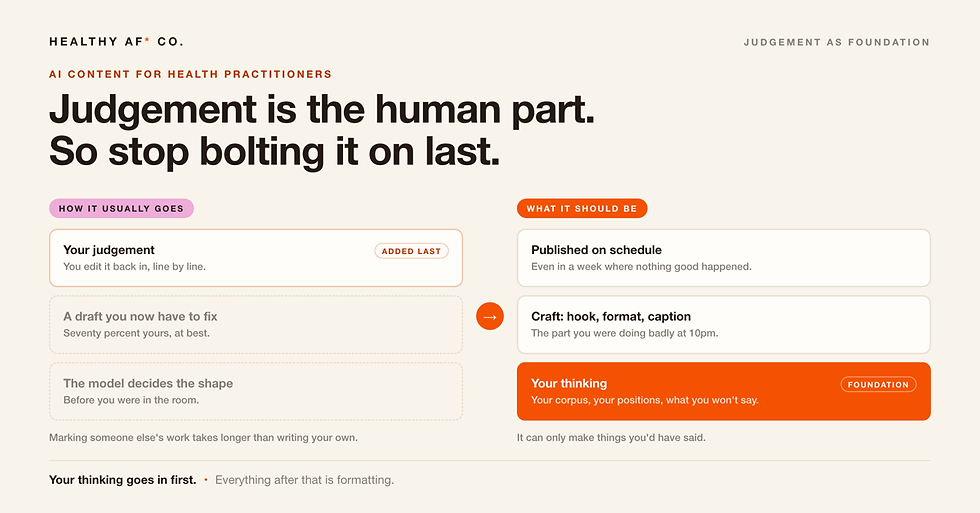
I wrote a blog a few weeks ago called The Clinical Authority Matrix, and the whole argument was that practitioners need to stop creating content as information deliverers and start creating content that proves clinical authority. This is the next layer down. The Anthropic data is the receipt.
I'm not writing this from the outside, by the way. I'm in the weeds with you. I'm watching my own content evolve, watching what AI is doing to search behaviour in real time, pivoting the whole agency in response, getting it right some weeks and getting it wrong others.
None of us have this fully figured out yet. The practitioners who are scared of AI are the ones who built their practice on being information deliverers. The ones who built it on judgement, relationship, implementation, and synthesis? AI just made you more obviously valuable, not less.
This isn't a threat. It's the clearest invitation we've had in a decade to do the work only we can do. Innovation matters. The practitioners who lean into it, who let the data show them where the real gap is and adjust their content accordingly, are the ones whose practices will look completely different in two years.
The rest will keep posting "Tips To" carousels.
If you're ready to create a content strategy that's built on compounding authority, let's chat.

Comments