
Why I Moved My Entire Agency to Claude (And What I've Built So Far)

I've been using AI in my business since May 2022. ChatGPT launched that November, and I was on it immediately. Built custom GPTs. Wrote detailed custom instructions. Uploaded robust knowledge files, brand brains, customer avatars, voice guidelines. I wasn't dabbling. I had a system, and it was producing genuinely good output.
For almost three years, I thought I was ahead of the curve. And honestly? I was.
The problem wasn't me. It was the platform.
What I Didn't Realize About How ChatGPT Actually Works
I had done everything right on my end. Detailed brand brains. Layered knowledge files. Custom instructions that took hours to build. And the outputs were good. Sometimes really good.
But I kept hitting the same wall. I'd open a conversation and the GPT just... wasn't reading the files I'd uploaded. Or it was skimming them. Or it was pulling details from a document I'd replaced three weeks ago. I'd reprompt the same context, over and over, trying to figure out why it wasn't retaining what I'd already given it.
The frustration wasn't that it couldn't produce. It could. The frustration was that it couldn't maintain. Every conversation felt like starting over. The nuance would drift. The voice would flatten. The clinical specificity I'd spent hours building into the knowledge base would just... vanish mid-thread.
What I finally understood was that this wasn't a setup problem. It was an architecture problem. ChatGPT isn't built to deeply read and hold complex documents the way I needed it to. The memory is siloed. The context doesn't carry. I was building a clinical library and expecting it to work like a clinician, and instead it kept handing me wellness platitudes.
Then I started actually learning how Claude works. Not just playing with it. Understanding it. And the difference isn't better prompts. It's better inputs. Deeper context. The ability to read layered, complex information and hold the kind of nuance that health practitioner content actually demands.
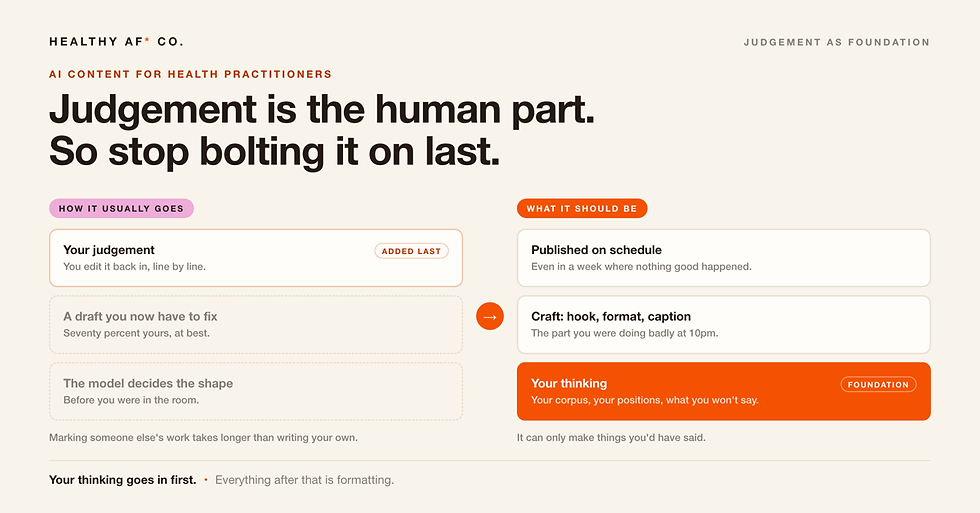
Once I stopped treating AI like a prompt engine and started treating it like a system I could teach, everything changed.
What I've Built So Far
I've been deep in this for about 10 to 12 weeks now, and I still feel like I'm behind. There's so much more I want to build. But even at this stage, here's what's already running:
I turned my content methodology into a system. The Clinical Authority Method is how we plan and produce content for every client. Not a content calendar. A strategic framework that maps clinical expertise to content that actually builds trust. I taught the system how the method works, and now it builds monthly content strategies and production-ready briefs for all twelve clients. More consistent. More clinically specific. A fraction of the time.
I built an operating system that runs my agency. It reads my project management databases, knows what's due, what's overdue, who's behind, and what's stuck. It briefs me every morning before I've opened Notion. When a project phase is completed, it notifies the right team member through Slack automatically.
I made my brand voice perpetual. And no, I don't mean I built a voice document. Lots of people have done that in ChatGPT. What I mean is that my voice, my audience, my methodology, and my brand positioning exist as permanent knowledge across the entire ecosystem. I don't upload it to every project. I don't paste it into every chat. It's just there. Every tool, every project, every workspace reads it automatically before it writes a single word.
I systematized my content production. The system knows my blog architecture, my writing style, my internal linking strategy. It writes drafts that need fewer edits than anything we've produced before. It publishes directly to my website as draft ready for review.
I built a capture system that sorts my brain. When I have an idea mid-conversation, mid-meeting, mid-school-pickup, I dump it. The system categorizes it, routes it to the right place, and I never lose a thought to a forgotten note again.
I built a CFO dashboard. I upload my monthly financials and get back a
categorized ledger, visual dashboard, cash forecasting, and tax reserves. It runs my books every month without me opening a single piece of accounting software.
Six systems. All built within the last few months. And I'm just getting started.
Is it perfect? No. It doesn't do everything I envision yet. But what I actually learned is how to build foundations that are system-agnostic. Even if something newer and shinier comes along tomorrow, I can move faster now because the thinking is documented, structured, and portable.
That's the part that hit me hardest. When I went back to ChatGPT to pull everything I'd built over the past three years, it was all trapped. Buried in old chats. I tried intense prompting, memory extractions, everything. It literally could not reconstruct what I'd spent years building inside it. With Claude, the knowledge lives outside of any single conversation (mind-blown).
Why This Matters If You're a Health Practitioner
AI tools are only as good as the knowledge you feed them. And if you've spent 5, 10, 15 years building clinical expertise, that knowledge is the most valuable input you have. Most people don't know how to package it in a way AI can actually use.
When you figure that out? You stop being the bottleneck in your own business.
Not "AI writes your content for you." It doesn't. But AI that understands your clinical lens, your patient language, your methodology? That's a different conversation entirely.
I'm Still in the Middle of This
I don't have it all figured out. I'm not standing on the other side with a tidy case study. I'm in the thick of building, breaking things, rebuilding, and realizing how much more is possible than what I've done so far.
But I keep getting the same question from practitioners: "Should I switch? Is it worth it? Where do I even start?"
Here's where I've landed. If you need AI that can read nuance, hold complex context, and follow an infrastructure system without losing the thread, Claude is where it's at right now. Not everyone needs to make the switch. But for how practitioners might want to use AI for their marketing and their businesses, where clinical specificity matters and generic outputs actively hurt you, it's a better fit than ChatGPT as of today.
That could change. This space moves fast. But right now, I'm building here. And I'm not looking back.

Comments