

Part 3 of 3: building AI that actually works for the business side of your practice.
My favourite part of being an ND was the people. The patients I got to know over years, the ones who came in stuck and slowly got unstuck, the little community that builds up around a practice when you've been holding people's hands through hard stretches for long enough. If you're an ND, I'd guess it's your favourite part too.
These days, a lot of that community gets built online first. Someone reads your blog, sees your post about the exact thing they've been dealing with, and books. Marketing is how they find you. And for most of us, it's a really heavy lift.
Why is marketing so hard for NDs?
Everyone I talk to knows what we should be doing. Blogging, so people can find us on Google and in ChatGPT. Posting on social. Emailing the list. Nobody needs another lesson on why.
The hard part is that we're the practitioner, the marketing department and the creative department, all at once. Ours is one of the only professions where the owner does the marketing, and it ends up being thirty or forty percent of the job, squeezed in around patient visits.
Last week I stood up in front of 48 clinicians and said that coffee and hope isn't a content strategy. Think about the patient who tells you she has no willpower because she couldn't keep up protein at breakfast. You know it was never willpower. She was missing everything that needed to be true for her to succeed: the groceries, the sleep, a backup plan for the bad mornings. Marketing works the same way. We do a few weeks of it beautifully, then life happens, and the notes app fills back up with good ideas that never go anywhere.
What I wanted to build
I had this idea about three years before AI could actually do it. I've been building with it since early 2023, and in February I moved my whole agency over to Claude. That's when the workflow that runs our content for 12 to 15 NDs every month really came together. In part one I told you how it remembers, and in part two I walked through what happens when you say "build my month."
Then in April I was sitting by an infinity pool in Corfu with Confident Clinician Retreat, chatting with other clinicians about AI and how you actually set it up so it works. The question I kept asking was how we get our message out there, as a profession. Jordan looked at me and said, "You need to build that." So I did. Kind of like having me in your pocket, without the agency price tag.

Somebody laughed at me last week when they realised I started building in June and I'm launching in November. To be fair, I move fast. But I also told a lot of clinicians I trust what I was making, and they kept asking me where it was. That's half of why it exists.
What's the difference between a chat, a project and a skill?
This was the question I got most last week, and I think it's the right one to start with.
Here's the analogy I used. One of our biggest beefs with conventional healthcare is that it works in silos. You see the gynaecologist, the neurologist, the cardiologist, and nobody's connecting gut health to mood or nutrition to hormones. That's what we do as NDs.
A Claude project works a lot like a specialist. You give it everything about you, it gets really good, and then that knowledge lives in that one project. Start something new and you're copying and pasting it all over again. That's on purpose, so information doesn't leak between projects, but it means you're the one carrying everything from place to place.
Skills are genuinely great, and if you've built one you know how good it feels. A skill is a recipe: how a blog gets built, how your carousel flows. But a recipe isn't a chef. When people tell me they want AI to just run their social media, what they need is:
A chef who knows the whole process, start to finish.
The recipes, so it's made the way you like it.
Groceries, which are your ideas, your notes, your visits and your voice.
A plate, so the finished thing goes somewhere: your website, your scheduler, your inbox.
Memory, so you're not telling it twice that you already posted about iron last month.
House rules, so it knows what it can do on its own and what waits for your okay.
So what is it?
It's called the Clinician Marketing Fix, and it's the chef plus the kitchen, built out of your own words.

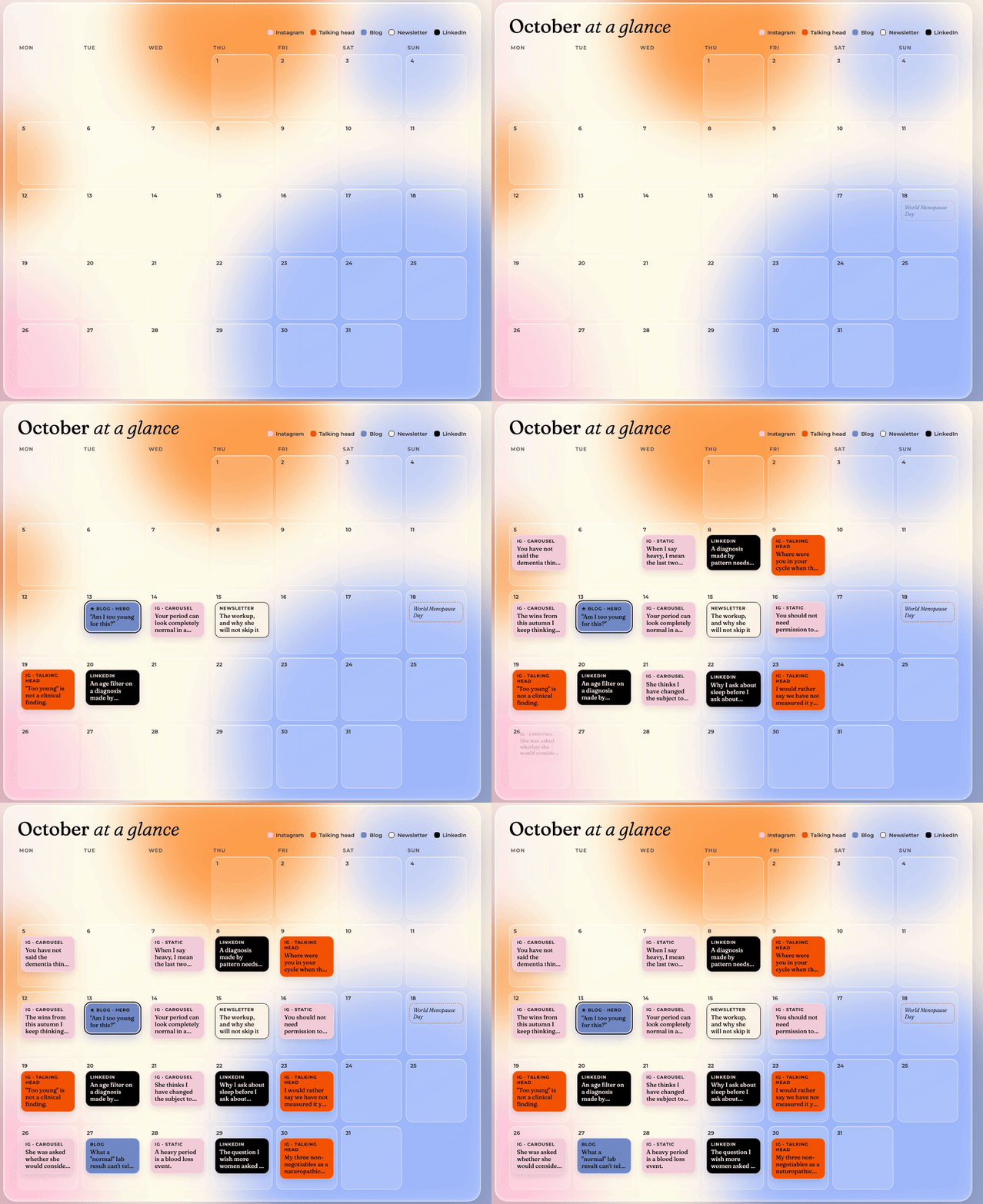
We're all using the same AI. What you put on it is what makes it yours. Underneath, it holds who you are (your voice, your beliefs, the words you'd never use, your compliance lines), the topics you want to be known for in your town, a second brain of how you explain things and what patients ask you every week, the craft of how your blogs and captions get built, and a memory of what went out last month. Then it helps you make the reels and graphics, and stages your posts so nothing goes out until you've okayed it.
You saw the planning side in part two, so I won't walk you through the month again. The short version is that you say "let's plan this month," your whole month comes back on one page, and nothing gets written until you've approved it.
How do you get it set up?
You do it yourself, in one sitting, and it's a lot gentler than it sounds.
You download your system, open it in the Claude app with the folder attached, and say "set me up." Then it interviews you, mostly out loud, the way a colleague would over coffee. How you practise, what you believe, the things you'd never say, and how you explain the stuff patients ask about. If you'd rather write your answers down, there's a form that asks the same questions.
It asks a lot, and it's supposed to. If someone tells you they can run amazing marketing for you from just your website, I think that's a little naive. Your website is the polished version of you. The good stuff is in how you talk.
From that conversation it builds your Brand Brain, your Clinical Pillars and your Ideation Bank out of your own words. Then it shows you what it heard, quote by quote, and you tell it "that's me," "not me," or fix the line yourself. You sign off on your voice before a single post gets written in it.
What's in there besides the planning?
The piece I'm most excited about is your visits. So much of your best material gets said in the room and never written down. The Visit Miner takes the transcripts from Heidi, Practice Better or whichever scribe tool you use, keeps patient details on your own computer, and pulls out the questions patients keep asking and how you explain things back to them. I always say that if one person has a question, ten people have it. So when you've answered "can you have a period and not ovulate?" three times this month, that question lands in your Ideation Bank instead of getting lost by the end of the day.
The Authority Miner does the same with things you've already put out there. Drop in a podcast you were on or a talk you gave, and it banks your ideas and the analogies you reached for.
The Reel Cutter, still in beta, takes a talking-head video, picks your strongest hook, cuts the ums and retakes, and adds captions in your brand colours. You approve the edit first. It's how I cut my own reels now.
And when a draft doesn't sound like you, you say so in plain language. The Self Tune-Up shows you the fix, makes it on your yes, and that correction carries into every draft after it.
Why does it live in files on your computer?
Software is something you pay for every month, and the day you stop paying, you lose access to everything you put in it. That's not what I built.
Your system is a folder of files on your own computer. The Claude app reads it and does the thinking and the doing, but the information about your business lives with you. If something better than Claude comes along one day, whether Google makes it or someone else does, you take your folder and go. I use Claude because I love what it makes right now. I don't want anyone locked into it forever, me included.
The questions I keep getting
"I'm not techy. Like, at all." Nobody was born good at AI. It's brand new. You didn't arrive at school knowing the Krebs cycle either; you learned it. Being curious and okay with looking a bit foolish in front of your screen matters a lot more than being techy. There's a video library of plain-English walkthroughs, and for your first four months there are live group office hours every week, with an actual human in them (me), for when you get stuck.
"Is it just going to go do things on its own?" Not until you've seen it do the job your way. Your eyes are on it, you approve what it makes, and nothing gets posted without your okay. Autonomy is something you give it once you trust it, not something it starts with.
"Is this another subscription?" Nope. It's one price, and it's built as your AI foundation, so when you want to build more, you can. The one thing you need is your own Claude account. Pro runs it day to day. Setup is the heavy part, so on Pro it might pause and pick back up when your limit resets. That's the honest list.
"I've already built stuff with AI. Is that wasted?" Not at all. Bring the voice doc, the prompts, the threads you keep re-explaining yourself in. Drop them in when you set up and they get folded in, so nothing you've done goes to waste.
"What if AI changes?" It will, and that's mostly good news. The models get better on their own, and your files keep working with them. With the Self Tune-Up you can update your system yourself, just by telling it what to change.
Who it's for
It's for the ND or clinical practitioner with real depth, the kind with a niche, a point of view and patients who trust you, who does her own marketing and wants it to actually get done.
It's probably not for you if you'd rather hand your marketing over entirely and never see it. That's a different arrangement, and I still offer it. And if you don't have a clear point of view yet, it can't invent one for you. It amplifies your judgement, so it needs some to work with.
If it feels like you've already missed the boat
You haven't. The boat's just moving further from shore, and faster. You can get on now, while it's close, even if you feel a little seasick. Or you can do the 200 km swim to catch it later. I'd rather you got on now.

The internet has plenty of health advice from people who've never seen a patient. It could really use more of yours.
Doors open November 23. If you want a seat at the free webinar that Monday at 12:00 pm ET, I'll walk you through it there, starting with why the "30 posts in 30 minutes" prompt hasn't worked for you yet. Save your seat here.


