
"Content Creation Scares the Pants Off Me." So Let's Take One Idea All the Way.

An ND said that to me on a discovery call recently. Not "I don't have time." Not "I hate being on camera." The content part scares the pants off her, and then she told me exactly why. Because she doesn't know how to do any of it.
Best description of the problem I've heard, and it's nothing like the version the marketing world sells back to her. That version says she isn't consistent enough. She's a clinician with a full schedule and a working brain. What she's never had is someone showing her how to break one thing into its parts.
So let's do that with one topic, start to finish. Iron.
Why does one topic only give me one post?
Start with what you're already doing, because it isn't wrong.
Say the topic is iron. You'd reach for foods that boost your iron. Iron and heavy periods. Iron and brain fog. Iron and fatigue. Four posts, done by Thursday.
That's the topic layer, and every practitioner reaches for it first because it's the easiest thing to see. Keep it. It's your map.
Three things it won't do for you, though. By the following week you're staring at nothing again, because four subtopics is four posts and then it's over. And all four of them answer the same question anyway. What iron affects. Not one of them tells her what you'd do about it. Then there's the first one, foods that boost your iron, which is the single easiest question on the internet for a machine to answer, so you spent your Thursday competing with AI on its best day.
The layer above your topic list
It starts with one sentence you'd defend to a colleague at a conference:
By the time her bloodwork says anaemia, her iron's been in the basement for months.
That's a position, not a subtopic, and nobody can look it up. It's a call you make in the room. It's also why five completely different posts come out of it instead of one.
Five posts hiding in one sentence
This is where most content advice hands you a worksheet. I'd rather hand you the posts, because you'll recognize yours faster than you'll fill in a grid.
All five come out of that one iron sentence, and each one is a different kind of call you make.
1. The Stake in the Ground. "By the time her bloodwork says anaemia, her iron's been in the basement for months." Your position, said plainly. It's your strongest post and it's the one you assume everybody already knows. They don't.
2. The Thing She Was Told. "'Your iron is fine' and 'we checked your iron' are two different sentences." This is the one she screenshots, because somebody said the first one to her in April and she's still exhausted.
3. The Rule-Out. "Three things I look at before I blame iron for your exhaustion." You refusing to jump at the obvious answer is the most credible thing you can show anyone. Also numbered, easy to build, easy to swipe.
4. The Pattern I See. "You've been taking iron for a year and nothing's changed. That's information we can use." Every one of these women thinks she's the problem. Tell her she isn't and she'll follow you for two years.
5. The Call You Make. "I don't wait for anaemia to show up before I get interested." The one nobody else posts, because it commits you to something. One caution here, and only here: post the call, not the number. Your exact threshold, printed for strangers who aren't your patients, stays in the room.
Same sentence. Five completely different posts. Not one of them is "what is ferritin."
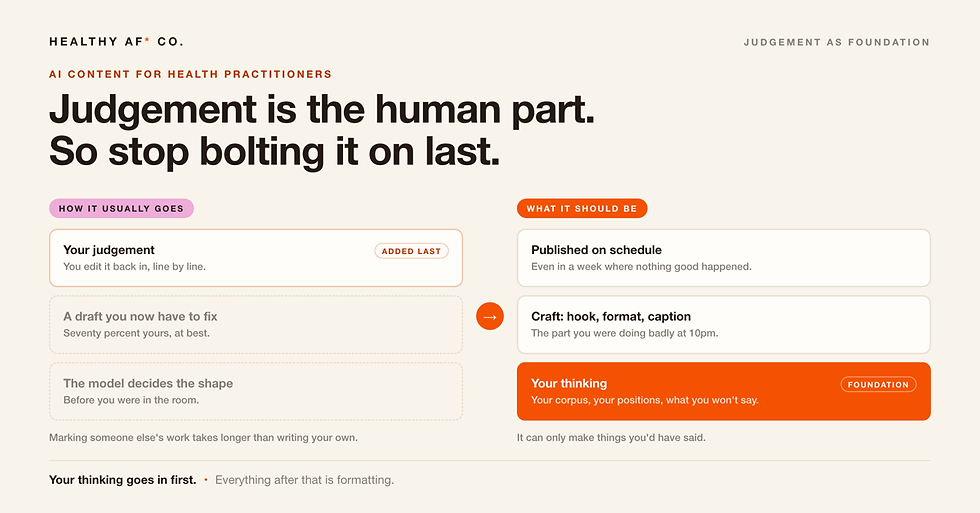
This is the part I don't think anyone is explaining. The fact is free, and any AI on earth will hand it to her in nine seconds. What it can't hand her is what you'd do, which is the only thing she's actually shopping for. It's also why judgement is the part that doesn't commoditize.
Your version of that sentence
Iron is my example. Yours is whatever you've been arguing about for ten years.
Thyroid. A TSH is not an assessment. "Normal" on a partial panel isn't normal.
Insulin. Glucose holds the line for years while she's already crashing every afternoon at three.
Perimenopause. It starts before anything confirms it, which is how "your labs are normal" and "you're too young" became the two most common dismissals in the field.
Run the five on any one of those and you have five posts nobody else can write.
How the two layers stack
Take one item straight off your topic list. Iron and heavy periods.
The topic layer gets you a post about heavy bleeding and iron loss, which is fine and which forty other practitioners published this month.
Run the second layer on it and you get The Thing She Was Told: "Heavy periods are just your normal" is the sentence that cost her three years of iron stores. Same topic. Completely different post, and now it's unmistakably yours.
That's how they work together. Your topic list tells you where to stand. The layer above it decides what you say once you're standing there.
Now make it something she'd actually stop for
You've got the post. Next question is the cheapest decision of your week: what does this get built as?
The Rule-Out is a carousel. It has steps, and steps want to be swiped.
The Call You Make is a talking head. Your face doing the disagreeing is most of the message and no graphic is going to carry that for you.
The Pattern I See is a static. One image, one line, because that post's whole job is to be screenshotted and sent to her sister.
Then there's the format everybody forgets, and it's the one people love most. Behind the scenes. "Here's what I said to a patient on Tuesday." She isn't being taught. She's seeing how you actually think, and that beats being taught every single time. Build it whichever way the conversation went: a carousel if it had steps, a Twitter-style static if it was one good line, text over B-roll if she needs to hear it in your voice.
A handful of templates you reuse covers every one of these. You don't need a hundred one-offs. People think the answer is volume. The answer is a library. The hour you're losing in Canva isn't just design time, it's decision time, and right now you're making every one of these calls at once with a blank square open. Which, honestly, is enough to put anyone off content for a year. I've written about drowning in the design before.
How many content ideas do naturopathic doctors actually need?
About ten posts per position before it starts going stale. That's what I see. Most of those five questions have more than one post in them, which is where the ten comes from. But one position is not an infinite content engine, and anyone telling you it is hasn't had to write the eleventh.
Which means five positions is most of a year, and that's the whole reframe. You don't need a longer list. You need five sentences you'd defend.
Every one of those five is a decision you've already made. You're not generating them, you're writing them down. You were never short on ideas. You were counting the wrong thing.
Pick one position this week. Write it as a single sentence you'd defend, then ask then ask the five questions of it. That's most of a month, and every word came out of your head, which is precisely why it'll sound like you.
If you want a second brain on which five positions to build on, that's most of what a first call with me looks like. Let's chat.

Comments