
We All Agree Judgement Is the Human Part. Nobody's Saying What to Build.
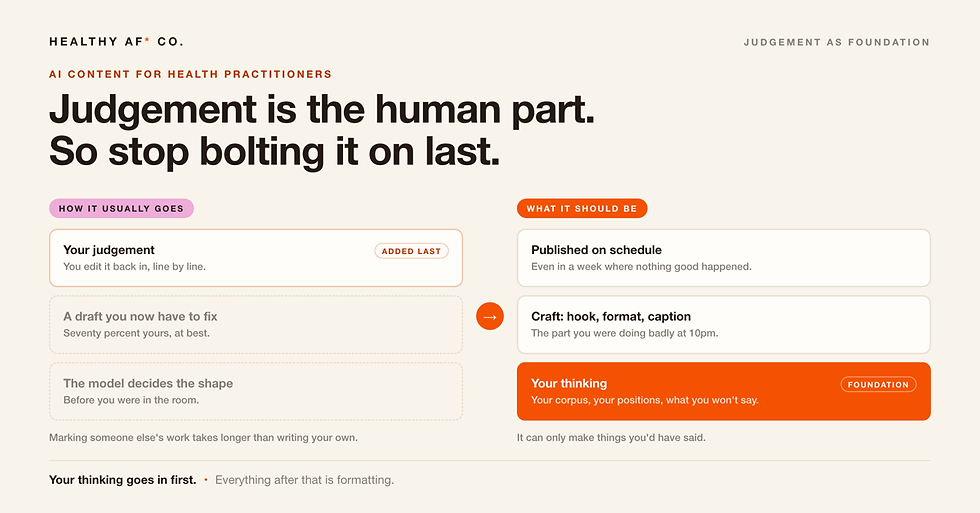
Judgement is the part that stays human.
Everybody in the AI conversation has landed there. The people building the models, the people worried about the models, the people selling courses about the models. Discernment. Taste. Knowing which of four true things is the one that matters for the person in front of you. Relationship. The read you get in the first ninety seconds of an intake. The things that don't reduce down to information.
Fine. Agreed. Now what.
That's the part I can't find anyone talking about. We've all settled on where the human line is, and almost nobody has said what a system built along that line would actually look like. It gets treated as a reassurance instead of a spec. Judgement matters, don't worry, you're still needed. Great. Where does it go? What holds it? What happens on a Tuesday when there's a caption to write?
My answer, after six months of building: AI content only sounds like you when your thinking is what it's built from, not the edit you make at the end.
You already have the judgement
Let me be clear about something first, because practitioners undersell this constantly.
You have authority. You have a point of view. You have a methodology, an actual repeatable way you move through a case that you could describe out loud right now if someone asked you the right question. Most of you have never written a word of it down, and it's still completely there. It shows up in the order you ask things. In what you check before you'd ever mention a supplement. In the claim your entire niche makes that you quietly won't make.
Ten of us in the same city are talking about the same systems. The topic list is basically public. What isn't public is how you explain what's happening in the two weeks before a period, the version you've given so many times you've stopped hearing yourself say it. The order you walk someone through hormone metabolism, because you've learned exactly which part they get stuck on. Patients don't pick you because you knew about progesterone. They pick you because of how you explained it.
So the judgement isn't missing. It was never the gap.
The gap is that none of it lives outside your own head. All of it gets stuck inside a visit.
The question I've gotten obsessed with
I've spent a long time on one half of this. A while back I wrote that clinical authority is a stack, four layers of it: your expertise, your philosophy, the human, the proof. The argument was that expertise on its own stopped differentiating anybody the moment a model could explain physiology for free, and that what separates you is the whole stack showing up, in your voice, consistently.
I still believe every word of that. But I ended that piece on the word consistently, and consistently is doing an enormous amount of work in that sentence.
Because that's the content question. The one I can't stop turning over is the structural one sitting underneath it.
What does it take to build something where your thinking is the thing the whole system is standing on?
Not referenced. Not consulted. Not pasted in at the top of a prompt. The foundation. Built so it can't hand you something you wouldn't say, because there's nothing else in there for it to pull from.
Why Doesn't AI Content Ever Sound Like You?
Because of the order it happens in. Look at how this actually goes right now.
You open a chatbot. You ask it for a post about PMS and PMDD. It gives you two hundred words that are, honestly, not totally wrong. Nothing in there is dangerous. It's just not what you would have said, it's not in the order you'd have said it, and it's missing the one distinction you make every single time you talk about this. So you start fixing it. You cut the opening. You rewrite the second paragraph. You add the caveat you always add. Twenty-five minutes later you've got something that's maybe seventy percent yours and still reads like a stranger built the frame.
It's the difference between writing a test and marking one. Anybody who has graded a stack of papers knows that correcting someone else's thinking is slower and more irritating than doing your own, and what you end up with is worse than if you'd just started from a blank page. That's the real reason people quit AI. Not because it was bad. Because fixing it cost more than doing it.
Your thinking arrived last. It showed up as a correction layer on something a model had already decided the shape of. You weren't in the room when it was written, so the only move available to you is arguing with it after the fact.
And plenty of practitioners never even get that far. They tried it once, looked at what came out, decided it wasn't accurate enough or wasn't theirs enough to put their name on, and closed the tab. It's been closed since. Then it's back to doing all of it yourself at 9:40pm, which isn't happening either, because there isn't time.
What Should You Actually Hand Over to AI?
Be specific about which half. This is the piece I'd want a practitioner to sit with even if she never works with me.
You are not handing over "content." You're handing over one specific half of a job, and if you can't say which half, that's the whole problem.
The half that stays yours: what's worth saying this month. What's true. What you refuse to claim. How you'd describe hormone metabolism to someone who's frightened, versus how you'd describe it to a colleague. Which of the six things a patient mentioned is the thread worth pulling.
The half that can go: turning that into a carousel. The fourth caption of the week. Not opening three posts in a row the same way. Formatting. Scheduling. Getting something published in a week where nothing good happened.
That split isn't a compromise. It's the only arrangement where what comes out is honestly yours.
What has to be true for it to work that way
Three things, roughly, and none of them are prompts.
Your own work has to be the raw material. Not a document describing your voice. The actual body of it: podcast episodes you guested on, old blogs, the talk you gave to the association, patient handouts, newsletters, a session you recorded. What you have already said, in the words you said it in. A description of your voice and a record of your voice are two different objects, and only one of them is usable.
There has to be a point where it stops and checks with you. Not at the end, when you're proofreading. Before, at the level of what's about to be talked about at all. Something either sounds like you and you'd stand behind it, or it gets rewritten into how you'd put it, or it doesn't run. Otherwise you get captions that are technically correct and completely generic, because correct is the only bar the machine can actually clear on its own.
It has to go somewhere. A better draft that never gets scheduled is the same as no draft. This is where most practitioners break, not at the writing. Two good weeks, then six weeks of nothing, because nothing carried over from the good weeks.
Try this: three questions, hit record
The fastest way to get your thinking out of your head is to talk, not type. So don't write anything.
Open Loom, or start a Zoom with nobody in it, and answer these three out loud like you're talking to a colleague:
1. Walk through the last patient you saw with cyclical symptoms, start to finish. What she said first, what you thought before she finished the sentence, what you actually did. Say it the way you'd say it over coffee, not the way you'd chart it.
2. What does everyone in your niche say about this that you won't say? And the part that matters more: why not.
3. Pick something you explain constantly, and explain it twice. Once to someone who's scared. Once to a colleague. Same mechanism, both versions, out loud.
Then download the transcript. That's it. What's in that file is the thing every AI tool you'll ever touch should have been working from in the first place, and almost none of them ask you for it.
Knowledge got commoditized. Judgement didn't, and it isn't going to.
So build like that's true.
This is what I've been building for the last six months. I'll be looking for beta testers in August, so keep an eye out. If you already know you want in, send me a DM on Instagram @healthyaf_co.


Comments